Living in time
On a layered experience of time
The apartment where I lived with my parents for the first year of my life is less than two miles from where I live now. Once in a while I’ll walk by it and try to imagine 36 or 7 years in the past. I picture my parents walking by, pushing me in a stroller. I wonder which perspective fits better now, my baby self or my thirty-something parents. But I have no memory of living in that apartment. The closest I can imagine is my parents on the other side of the first-story window, the window behind the short palm tree.
My mother tells me that the apartment got so hot in the summer, she accidentally cooked her goldfish by placing their tank too close to the window. From old photos, I can imagine her oversized sweaters and glasses, her straight-leg jeans. I imagine my father with his hair long enough to show its curl, wearing a brown suit. Our cats, Agatha and Christie, one year older than me, young and agile. I try to picture myself but can only see photos.
Things that collapse time: a place, a person, a song, a flavor. The view of tall, skinny palm trees sticking up over the freeway walls. The blue light that comes in through the windows at dawn. The sound of the upstairs neighbors sliding their closet door open at night, as if they were my parents packing for a trip.
I used to think I was a nostalgic person because I thought so often about the past. But now I don’t think of this as nostalgia. As a child, I looked back, tried to make memories concrete through writing, because I was always moving. After a year in that first apartment, we moved across the country, then moved again one year later, starting a series of moves that didn’t end until I was 16 years old and we returned to Southern California. I didn’t want to return to the past so much as to my last familiar life, which was always changing.
Now, I feel time differently. There’s no earlier time I want to return to, only the presence of other times written on the landscape all around me. Maybe I have finally lived somewhere long enough to feel these echoes without moving.
Agapanthus blooms on a foggy, early-summer morning, heavy with dew. The smell of jasmine. Boiling water for tea while everyone else is asleep. Pushing Aya in a stroller and seeing her arms stick out, reaching for leaves. Walking after dark past the church where white, winged insects flicker over the grass.
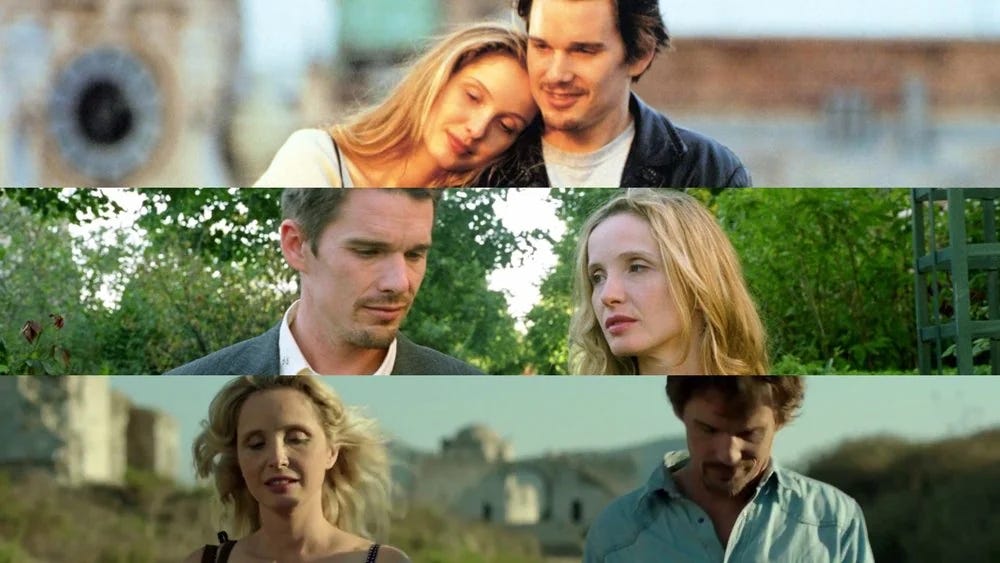
Recently, in my ongoing effort to be less afraid of films that make me feel, I stopped watching Love Island and watched the Before trilogy instead. I had maybe seen Before Sunrise once, long enough ago that all I remembered about it was that the characters seemed grown-up to me at the time. They are 23. What I admire most about these films now is how the container of time creates natural tension that lets the story unspool without plot. It feels honest to me to acknowledge that time is the only real plot we’re given, and it is already full of feeling.
The way Jesse and Celine grow to love each other in the nine years they spend apart between the first two films, because they shared a moment and then time passed, feels like the way I grow to love places, people, life. I feel it also for the actors as I watch them age from one film to the next. There is a tenderness inherent to aging, in the passage of time showing itself on Ethan Hawke and Julie Delpy’s faces. Over the years and hours, they become familiar to me, and I wonder what experiences each have gone through, the actors and the characters, in the time we don’t see. I’m touched also by their long artistic collaboration, by Ethan Hawke working with director Richard Linklater, both from Texas, for over thirty years. The reality layers onto the fiction and the whole is moving.
A child’s life marks time more dramatically than an adult’s. Before having Aya I sometimes felt I was floating through the years of adulthood. Time passed, but without long-distance moves, grades in school, or major developmental milestones, I felt I was living one long, continuous phase, the longest of my life, which was disorienting.
I wanted to rewatch Boyhood (Linklater’s 2014 film shot over 12 years so its characters age naturally) for this essay too, but I’m trying to make peace with my own containers of time. Caring for a toddler demands a fluid relationship with time — at once managing a schedule, seizing available moments to do things like write or wash clothes, practicing patience with a little being whose experimentation and development depend on it, and letting go of everything that is not possible in the moment. This time is threaded with sweetness and joy and exhaustion and grief, but being able to experience the richness of all of that at once feels like the gift of aging.
Anpan from Yamazaki Bakery. Passing the turnoff to the old site of our parenting class, which has been closed since the fire. Lying in the grass on a blanket, feeling the uneven ground beneath me and the clammy dusk air between my skin and my clothes. The opening, harmonic oohs of “Don’t Worry, Baby.”
When I am trying to stay present, I think of it as grounding, but maybe that is the wrong way to imagine positioning myself in a shifting medium. In Before Sunrise, Celine and Jesse meet a poet who says we are “lodged in life like […] branches in a river.” That feels right, like life, or time, is flowing through us, around us, carrying us. I often think about how, by the time I am better rested, Aya will be in a new life stage. I don’t wish the time forward, as if I needed to. It moves, indifferent to me. But I am trying to feel the river around us, where it eddies, where it meets another body.
“I believe if there’s any kind of God, it wouldn’t be in any of us. Not you or me, but just this little space in between,” Celine says in Before Sunrise. “If there’s any kind of magic in this world, it must be in the attempt of understanding someone, sharing something. I know, it’s almost impossible to succeed. But who cares, really? The answer must be in the attempt.”
The next two films, especially the last one, Before Midnight, show how continual this attempt must be in a relationship. I feel this in my partnership, but right now I feel it most acutely in my writing life and my presence with Aya. How to show up as I am, accepting my tiredness and limited time, knowing the result will be imperfect but also meaningful, the beauty in the attempt. (“To essay” means “to attempt,” as you have heard countless times if you are also a creative writer, but I love this about the form.)
The way aging comes with life experience, almost definitely including disappointment and baggage, makes the clarity of youth easy to romanticize. Looking back, I do love that feeling of newness, though I wouldn’t have called it that at the time. Is it too much to say I sometimes feel my youth beside me like a friend? Writing down the quotes from Before Sunrise, eating anpan in Japanese Village Plaza before my first day of post-college work, lying in the grass on the same blanket I use for picnics now but on campus, surrounded by friends I won’t stay in consistent touch with but who come back into my life unexpectedly, the surprises made possible by years passing.
This week I interviewed a poet, my first author interview since Aya was born. His upcoming book is in part a journey of self-acceptance. I rambled around the question I felt foolish for wanting to ask: Is this an ongoing effort? He said, and I am paraphrasing, we reach a resolution for a poem or a book, but that resolution is only for the moment of the work.
You could take this to mean that a work of art with resolution is not representing reality. But I hear the opposite. We make contact with resolution, or moments of meaning, again and again. Maybe they layer. Maybe they surround us like friends.
Journaling prompt:
Make a list of things that collapse time for you.
One thing I loved this week:
“Girl You Better Try to Have Fun,” Megan Stielstra — I wanted to work this essay into mine because it is all about layered time, and Megan, who I was lucky enough to have as a teacher, is especially good at this. I couldn’t find a way to do it in the time I had, but I think you should read her essay.
“We stopped. The wind stopped. I could hear my own heartbeat. At work I’d been editing a book about eternalism, the philosophical theory that the past, present, and future are all happening simultaneously, and it felt like proof. I was 46. I was 16. I was 60, 70, 80, looking back down the line of my life to that moment by the river when everything made sense.”
Also!
If you have made it this far down, thank you for reading! This week, I reached my first 100 subscribers to this newsletter, and I wanted to do something to celebrate. If you send a reply to this email, I will randomly choose at least five people to send a postcard with some kind of fun surprise, like a poem, a reading recommendation, a sticker, etc. (Or, if you’re reading this somewhere that isn’t email, you can email me at miamonnier at gmail dot com.) Anyone welcome, whether I know you in real life or not! And thank you again for the precious gift of your time <3